Showing posts with label Science & Technology. Show all posts

Monday, January 29, 2024

బ్యాకప్‌ అవసరం లేకుండానే వాట్సప్‌ చాట్‌ బదిలీ


  • బ్యాకప్‌ చేయకుండానే వాట్సప్‌లోని చాట్‌ హిస్టరీని కొత్త స్మార్ట్‌ఫోన్‌కు బదిలీ చేసుకునే సదుపాయం అందుబాటులోకి వచ్చింది. ఇందుకోసం వాట్సప్‌ చాట్‌ ట్రాన్స్‌ఫర్‌ ఆప్షన్‌ను వినియోగించుకోవాలి. 
  • క్లౌడ్‌ ఆధారంగా పనిచేసే బ్యాకప్‌ కంటే ఈ ప్రక్రియ చాలా వేగంగానూ, సులభంగానూ ఉంటుంది. ఇందుకోసం రెండు (పాత, కొత్త) ఫోన్లూ మీ వద్దే ఉండాలి. అవి రెండు ఒకే వైఫైకి కనెక్ట్‌ అయ్యి ఉండడంతో పాటు, లొకేషన్‌ సర్వీసు కూడా ఆన్‌లో ఉంచాలి.

బదిలీ ఇలా..

  • ముందు మీ పాత ఫోన్‌లో వాట్సప్‌ ఓపెన్‌ చేసి సెట్టింగ్స్‌లోకి వెళ్లాలి.
  • చాట్‌ సెట్టింగ్స్‌లోకి వెళ్లి అందులో చాట్‌ ట్రాన్స్‌ఫర్‌ ఆప్షన్‌ను ఎంచుకోవాలి.
  • చాట్‌ ట్రాన్స్‌ఫర్‌కు సంబంధించి ప్రక్రియ మీ పాత ఫోన్‌లో ప్రారంభం అవుతుంది. ఇక్కడో క్యూఆర్‌ కోడ్‌ స్కానర్‌ ఓపెన్‌ అవుతుంది.
  • తర్వాత కొత్త ఫోన్‌లో వాట్సప్‌ ఇన్‌స్టాల్‌ చేయాలి. అదే ఫోన్‌ నంబర్‌తో లాగిన్‌ అవ్వాలి.
  • పాత ఫోన్‌కు వచ్చే వెరిఫికేషన్‌ కోడ్‌ను కొత్త దాంట్లో ఎంటర్‌ చేయాలి.
  • కొత్త ఫోన్‌లో చూపించే క్యూఆర్‌ కోడ్‌ను పాత ఫోన్‌లో చూపించే స్కానర్‌తో స్కాన్‌ చేయాలి.
  • ఆ తర్వాత పాత ఫోన్లో ఉన్న డేటా మొత్తం కొత్త ఫోన్‌లోకి బదిలీ అవుతుంది.
  • కొన్ని నిమిషాల పాటు కొనసాగే ఈ ప్రక్రియ సమయంలో రెండు ఫోన్లూ పక్కపక్కనే ఉంచాలి. స్క్రీన్‌లూ ఆన్‌లోనే ఉంచాలి.

Iran : కక్ష్యలోకి మూడు ఇరాన్‌ ఉపగ్రహాలు


  • మహ్దా, కయ్హన్‌-2, హతెఫ్‌-1 అనే మూడు ఉపగ్రహాలను తాము విజయవంతంగా ప్రయోగించినట్లు ఇరాన్‌ 2024 జనవరి 28న ప్రకటించింది. 
  • దేశీయంగా అభివృద్ధి చేసిన సిమోర్గ్‌ రాకెట్‌.. వాటిని 450 కిలోమీటర్ల ఎత్తున ఉన్న కక్ష్యలోకి చేర్చినట్లు తెలిపింది. మహ్దా పరిశోధక ఉపగ్రహమని.. కయ్హన్‌-2 జీపీఎస్‌ కోసం, హతెఫ్‌-1 కమ్యూనికేషన్‌ కోసం ఉపయోగపడనున్నాయని వెల్లడిరచింది. 
  • ఇరాన్‌ తన బాలిస్టిక్‌ క్షిపణి సామర్థ్యాలను మెరుగుపర్చుకునేందుకే తాజా ఉపగ్రహాలను ప్రయోగించిందని పశ్చిమ దేశాలు ఆరోపించాయి.

Tuesday, August 25, 2020

“MY IAF”: Indian Air Force launches new mobile application for aspirants


As part of the ‘Digital India’ initiative, the Chief of the Air Staff, Rakesh Kumar Singh Bhadauria has launched a mobile application named ‘My IAF’ containing career-related information with job details that are going to be useful for candidates.

How will it serve the candidates?

The app will serve the candidates by providing information regarding the selection process, training, pay scale, and other important details for the post of officer and airmen.

About the app

  • The Centre for Development of Advanced Computing (C-DAC) has developed the mobile app.
  • The app will provide brief information about the history and stories of IAF.
  • It contains entertaining videos and adventurous games.
  • Other than the candidates, one can have the experience to observe the aircraft in the inventory.
  • Real-time updates of IAF will also be visible.

What is the function of C-DAC?

The Centre for Development of Advanced Computing is an autonomous scientific society, founded in 1988 and conducts its operation under the Ministry of Electronics and Information Technology. It is associated with various research initiatives related to the High-Performance Computing, Multilingual Computing and Heritage Computing, Professional Electronics, Software Technologies, Health Informatics, and Education.

Indian Air Force

IAF is the supreme air arm of the Indian Armed Forces. It was founded in 1932. It is headquartered at New Delhi (Vayu Bhawan). The motto of the organization is ‘Glory that touches the sky’. Arjan Singh is the first and only Officer to be promoted to the five star rank of Marshal of the Indian Air Force.

ASTROSAT detected UV light from a galaxy, 9.3 billion light-years away


Pune based Inter-University Centre for Astronomy and Astrophysics confirmed that the AstroSat satellite has detected an extreme ultraviolet (UV) ray from a galaxy that is 9.3 billion light-years away from Earth.

What is ASTROSAT?

  • Astrosat is the first multi-wavelength space telescope launched by ISRO from Satish Dhawan Space Centre in 2015. 
  • It has a set of five unique X-ray and ultraviolet telescopes. The mission duration was planned for 5 years.

About the IUCAA led global team

  • The discovery of UV light was conducted by a team that consists of scientists from India, Switzerland, France, the USA, Japan, and the Netherlands.
  • The team was led by Dr. Kanak Saha.
  • The news of the discovery was published in an online, peer-reviewed, scientific journal called “Nature Astronomy”.
  • The team observed the galaxy that is located in the Hubble Extreme Deep Field.

Key findings could be made

  • It will help to find how the dark ages of the universe ended and transition in the light ages took place in the universe.

NASA’s previous approach

  • NASA’s Hubble Space Telescope was commissioned with the same objective as ASTROSAT but it failed to detect any UV emission. 
  • As reported by experts, the background noise in the ultraviolet detector of ASTROSAT is much less than that of the Hubble Space Telescope.

Tuesday, July 14, 2020

SHUDH: UV Sanitizing Device developed by IIT Kanpur


The IIT Kanpur has developed an Ultra Violet Sanitizing product called “Shudh”. The device is capable to disinfect 10 ×10 square feet room in just 15 minutes

Highlights

  • The disinfection helper, SHUDH is smartphone operated and is handy. 
  • It has six UV lights. Each UV light is of 15 watts. 
  • The device can be used to assist at highly prone places such as hotels, hospitals, malls, offices and schools.
  • As it has the feature of smartphone attached to it, the device can be operated remotely as well.

UV Sanitization

  • Usually UVC (Ultra Violet-C) is used to kill micro organisms. 
  • This includes drug resistant bacteria as well. 
  • UVC is the most dangerous to human beings, especially to their skin and eyes. 
  • The other UV forms such as UV-A and UV-B can cause sunburns and premature aging.
  • UVC light does not reach the earth surface as the atmosphere absorbs it. 
  • The UVC used in sanitizers is man made.

Friday, July 10, 2020

World’s First Reusable PPE Kits with Triple Viral Shield Technology launched


Indian Manufacturing Company- Loyal Textile Mills on 9th July 2020 launched the first of its kind in the world- reusable PPE (Personal Protective Equipment) Kits. Along with reusable PPE kits, reusable garments and face masks with zero virus penetration were also unveiled by Loyal Textile Mills.

  • The reusable masks, garments, and PPE Kits was launched by Loyal Textile Mills with collaborating with Reliance Industries Limited and Switzerland based textile innovation company- HeiQ Materials AG.
  • The 3 products will be available in the market under the brand ‘Supera Shield’ of Loyal Textile Mills.

Triple Viral Shield Technology of the Reusable Masks, Garments and PPE Kits

  1. The reusable masks, garments, and PPE kits are made with the Viroblock Technology of HeiQ Materials AG.
  2. The fiber used for making the reusable masks, garments, and PPE kits was ‘R ELAN Fibre’ of Reliance Industries Limited. R ELAN Fiber inhibits bacterial and viral growth.
  3. Viral Barrier PU film Lamination: The fabric in the reusable mask and PPE kit has been engineered with viral barrier PU film lamination imported from the Republic of China (Taiwan).

Number of Times Reusable

As per Loyal Textile Mills, the garments and masks can be washed for up to 25 times for reuse while the PPE kit can be washed up to 10 times for reuse.

Thursday, July 9, 2020

IIT Alumni Council signs Agreement with CSIR-IGIB


On 8th July 2020, an agreement has been signed between the Council of Scientific & Industrial Research- Institute of Genomics and Integrative Biology (CSIR-IGIB) and IIT Alumni Council.

About the Agreement

  • As per the Agreement Signed, joint research work on COVID-19 will be conducted and data of COVID-19 positive patients will also be analyzed jointly by the CSIR-IGIB and the IIT Alumni Council.
  • Along with the statement for the signing of the agreement, it was also informed that Imaging data of over 8500 COVID-19 patients have been handed over to CSIR-IGIB by the IIT Alumni Council. 
  • The imaging data of 8500 patients are from the temporary COVID Care Facility at the National Sports Club of India Dome (NSCI Dome) at Southern Mumbai’s Worli. 
  • The imaging data will be provided in the de-identified form by the CSIR-IGIB.

First Line of MegaLab Mumbai by the End of July

  • On 29th May 2020, the IIT Alumni Council had announced that it will set up one of the largest COVID-19 testing facility of the world in Mumbai. 
  • The name of the facility will be MegaLab Mumbai. Mumbai University was announced as a partner for the MegaLab Mumbai initiative.
  • The MegaLab Mumbai will have three independent lines. First-line with a capacity of 1 million (10 lakh) tests per month), Second with 3 Million Tests per month, and the Third line with 6 Million Tests per Month. In combination, all three independent lines will have a total capacity of 1 crore (10 million) tests per month.
  • The First Line of the MegaLab Mumbai is expected to be ready by the end of July 2020, which will have the capacity to test 10 million samples per month.
  • MegaLab Mumbai is part of the C19 initiative. C19 initiative was launched by IIT Alumni Council in February 2020.

Tuesday, July 7, 2020

First of its Kind Project in the World Commissioned by Indian Railways in collaboration with BHEL


Under its Corporate Social Responsibility (CSR) Scheme, the largest power generation equipment manufacturer in India- Bharat Heavy Electricals Limited (BHEL) had undertaken a project with the Indian Railways for setting up a 1.7 MWp (megawatt peak) solar energy project at the Madhya Pradesh’s Bina district that will connect directly to the Overhead Traction System of the Indian Railways. The solar power project between the Indian Railways and BHEL was signed on 9th October 2019.

  • The solar power project was completed as of 6th July 2020 and is currently under extensive testing and trial. 
  • The solar power project is expected to be commissioned with 15 days. 
  • The Solar Power Project is the first solar power plant in the world in which the power generated from the plant will be directly fed to the Overhead Traction System of the Railways.

Challenges

  • The major challenge in the project was that the Indian Railways use single phase 25 kV AC (Alternating Current) in its Overhead Traction System to power the locomotives, while the Solar Panels at the Solar Power Plant produces DC (Direct Current) Power.  
  • Hence the DC power from the Solar Panels had to be converted into AC power.
  • High Capacity Inverters with single-phase output were installed for converting DC into AC power. 
  • To directly feed power to the TSS (Traction Sub Station of the Indian Railways), through the transformer the 25 kV AC is being stepped up from the inverters.

Benefits of the Project

  • The Solar Power Plant will save Rs 1.37 crore for the Indian Railways in a year.  
  • Approx 25 lakh units of energy every year will be produced by the Solar Power Plant for the Indian Railway.

Tuesday, June 30, 2020

Indigenously Developed ‘COVAXIN’ gets DGCI approval for Human Clinical Trials


The Drug Controller General of India (DGCI) has given approval for Phase I and Phase II human clinical trials for COVID-19 vaccine ‘COVAXIN’. In association with the Indian Council of Medical Research (ICMR) and the National Institute of Virology (NIV), COVAXIN is developed by Hyderabad based vaccine & bio-therapeutics manufacturer-Bharat Biotech.  At NIV Pune, the strain of SARS-CoV-2 was isolated before being transferred to Bharat Biotech.

  • COVAXIN is the first indigenously developed COVID-19 vaccine to be approved for Human Clinical Trials. 
  • The approval was granted based on the results from the pre-clinical studies of the vaccine. 
  • During preclinical studies, the vaccine has demonstrated safety and effective immune response.
  • The vaccine is developed at the high containment facility of Bharat Biotech- BSL-3 (Bio Safety Level 3). 
  • Human trials are expected to begin from the month of July in a phased manner.
  • Bharat Biotech has developed several vaccines over the last decades such as Polio, Rabies, Chikungunya, Rotavirus, Zika.
  • Last month, the Indian Government has announced that for developing a vaccine for the COVID-19 virus, as many as 30 Indian Companies are working on it.

Monday, June 22, 2020

Hetero’s injectable ‘Covifor’ gets DCGI approval for COVID-19 Treatment


For the treatment of COVID-19 positive cases, on 21st June 2020, Hyderabad based pharmaceutical company -Hetero Drugs has received approval from the Drug Controller General of India (a department under- CDSCO: Central Drugs Standard Control Organization) for manufacturing and marketing of antiviral drug Remdesivir.

Brandname for Marketing

  • Under the brand name ‘Covifor’, Hetero Pharmaceuticals’ generic version of Remdesivir will be marketed in India.
  • The drug is manufactured at the Hetero company’s Hyderabad facility, while its Active Pharmaceutical Ingredients (API) is being developed at Andhra Pradesh’s Visakhapatnam.

Remdesivir

  • The antiviral drug ‘Remdesivir’ is administered via injection into a vein. 
  • This antiviral medication was developed by the United States biopharmaceutical company Gilead Sciences for treatment of Hepatitis C.
  • United Kingdom, Singapore, and Japan are the countries where the drug has been approved to date for the treatment of COVID-19 cases.

Price and Availability

  • As it is an injectable drug,  it has to be administered under the supervision of a healthcare practitioner and will not be available through any retail channel. 
  • The drug will be made available for hospitals and government healthcare agencies. 
  • It will be available in a 100mg injectable dose. 
  • The price will be in the range of Rs 5,000 to 6,000 per dose.
  • Hetero has targeted to manufacture one lakh doses of it in the upcoming weeks, the company has stated that production can be increased based on the demand.
  • Covifor will be used for the treatment of confirmed COVID-19 cases for those who have severe symptoms of the disease.

Tuesday, June 16, 2020

Fifth State of Matter observed by NASA scientists


The NASA (National Aeronautics and Space Administration) scientists in the International Space Station unveiled the first results of Bose-Einstein condensate experiments under which the particles can be manipulated free from Earthly constraints.

Bose-Einstein Condensates

  • Bose-Einstein Condensates were predicted by Indian Mathematician Satyendra Nath Bose and Albert Einstein almost a century ago. 
  • The BEC is a state of matter that is typically formed when a gas of bosons is cooled to temperatures close to absolute zero.
  • Absolute Zero is the temperature at which the entropy and enthalpy of cooled gas reach their minimum value.

Four States of Matter

  • There are four state of matter namely solid, liquid, gas and plasma. 
  • The fourth state of matter called the plasma was described by the chemist Irving Langmuir. 
  • It consists of gas of ions in which orbital electrons are removed and positively charged nuclei roam freely.

Fifth State of Matter

  • The BEC is the fifth state of matter and was created by the scientists 25 years ago. 
  • When a group of atoms are cooled to absolute zero, the atoms clump together behaving as a one big super atom. 
  • This state is called the fifth state of matter and is referred to BEC.

Saturday, June 13, 2020

IIT Kharagpur: AI Based Social-Distancing Monitor


The Researchers of IIT Kharagpur have developed an Artificial Intelligence based cyber-physical system to monitor social distancing in public places.

Highlights

  • The device developed by the researchers will play a proximity alert whenever there is a violation of social distancing norms. 
  • The device captures field view and computes distances according to the criteria set by the Ministry of Health and Family Welfare.
  • The researchers of the institute have designed the device using inexpensive and easily accessible hardware materials.

Social Distancing

  • The social distancing is non-pharmaceutical prevention of an infection. 
  • This is done by decreasing contact between the persons that are infected by the disease-causing pathogen. 
  • According to WHO, when someone has COVID-19, the minimum physical distance to stay away from him is 1 metre. 
  • The same norms are followed in India as well.
  • Some countries follow 2 metres of social distancing and some others follow 1.5 metres. 
  • UK follows 2 metre distancing and Australia follows 1.5 metres.

‘GermiKlean’: Developed by DRDO to sanitise uniforms of police and security personnel


The Defence Research and Development Organization has developed ‘GermiKlean’. GermiKlean is a sanitising chamber that can be used to sanitise uniforms of security and police personnel.

Highlights

  • The DRDO developed the sanitizing chamber after the Delhi Police raised their requirement of sanitizing their helmets, uniforms, cane shields, etc.

About GermiKlean

  • GermiKlean is capable of sanitizing 25 pairs of uniforms within 15 minutes using dry heat treatment. 
  • Dry heating of an article is accomplished by conduction. 
  • Heat is absorbed by the exterior surface of the article and passed inward. 
  • Dry heat kills micro organisms by causing denaturation of proteins. 
  • Denaturation is a process in which the nucleic acids lose the quaternary structure. 
  • This kills the micro organisms.

Other measures

  • The DRDO has also designed sanitisation tunnel. 
  • It has come up with an idea of a mat that can be used to sanitise foot.

Tuesday, June 9, 2020

ANANYA: Disinfectant Spray developed by Defence Institute


The Pune based Defence Institute of Advanced Technology (DIAT) has developed Nano-Technology based disinfectant spray to fight against COVID-19. The spray has been named ANANYA.

Highlights

  • The spray can be used by common man, health care workers. 
  • Also, the spray can be used on a large-scale use as well. 
  • It can be used on masks, Personal Protective Equipment (PPE), elevator buttons, contaminated surfaces such as medical instruments, door knobs, rooms and corridors.
  • The spray has been prepared based on Nano-Technology assisted formulation. 
  • It will not only stop COVID-19 from entering the body but will also kill the virus that comes in direct contact.

About the spray

  • ANANYA is a water-based spray. It stays effective for 24 hours and is highly effective for more than 24 hours. 
  • The spray adheres to fabric, metallic objects and plastics. 
  • The toxicity of the spray is negligible to humans. The shelf life of ANANYA spray is more than 6 months.

DIAT

  • The Defence Institute of Advance Technology operated under Ministry of Defence. 
  • The institute trains officers of Indian Ordnance Factories, Coast Guards, Indian Armed Forces (Air Force, army and Navy). 
  • It was established in 1952.
  • The Defence Minister of the Chancellor of the Institute.

COVID BEEP


The Union Minister of India Shri Jitendra Singh recently launched COVID BEEP, the first physiological parameter monitoring system for COVID-19 patients.

About COVID BEEP

  • COVID BEEP is Continuous Oxygenation and Vital Information Detection Biomed ECIL ESIC Pod. 
  • It is the first indigenous wireless cost-effective parameter monitoring system. 
  • The COVID BEEP was developed by IIT Hyderabad and ESIC Medical College Hyderabad. 
  • It will greatly reduce transmission risk as it will help save resources such as Personal Protective Equipment (PPE).

Features

  • The COVID BEEP incorporated non-invasive blood pressure monitoring, ECG monitoring and also respiratory monitoring.

What is the Vital Information in Medicine field?

  • The vital information includes temperature, pulse, respiratory rate and blood pressure. 
  • Apart from these four vital signs, the fifth vital signs include pain, menstrual cycle, blood glucose level and oxygen saturation.
  • The sixth vital sign refers to end tidal carbon dioxide, shortness of breath, Gait speed (walking speed) or delirium. 
  • Delirium is the disturbed state of mind that occurs due to intoxication, fever or restlessness.

ARCI develop Ultra Violet based disinfection cabinet


The Advanced Research Centre for Powder Metallurgy along with the Mekins Industries have developed UVC based Cabinet to disinfect COVID-19 patients.

About the Cabinet

  • The Cabinet can be used to disinfect items used in commercial establishments and also in day to day life.

Need

  • During the early times of COVID-19, India was able to control the spread of the virus successfully. 
  • However, with the lock down being relaxed in phases, there are possibilities of slow spread of the disease. 
  • This might happen through surface contamination. 
  • In order to contain the spread, it is essential to widen the use of disinfection cabinets as the one created by ARCI.

Working

  • The Cabinet used Ultra Violet C radiation to disinfect the virus. 
  • The wavelength of UVC is 254 nm. When the UVC is absorbed by RNA of COVID-19, it leads to molecular structural damage to the virus. 
  • This is achieved through photodimerization process.

Saturday, June 6, 2020

CeNS: Low cost Catalyst for Hydrogen Generation


The scientists and researchers at the Centre for Nano and Soft Matter Sciences operating under Department of Science and Technology have invented a low cost effective way to generate hydrogen from water using Molybdenum dioxide.

Key Findings of the Study

  • The study says that Molybdenum dioxide can act as efficient catalyst to reduce energy used in splitting water into hydrogen and oxygen. 
  • The process is called electrolysis.

About Molybdenum Dioxide

  • Molybdenum Dioxide has the potential to replace the catalyst that is being used currently, that is, Platinum. 
  • Platinum is highly expensive and also is available as limited resource on the earth.

About the Study

  • The researchers grew Molybdenum Dioxide on tin oxide substrates.

Significance

  • The splitting of water is important to obtain hydrogen. 
  • Hydrogen is lately becoming a popular clean fuel. Hydrogen is predominantly used to make fuel cells. 
  • In a fuel cell, the chemical energy, that is hydrogen is converted into electricity.

Hydrogen Energy in India

  • The Ministry of Renewable Energy is supporting Research and Development on Hydrogen Energy and Fuel greatly. 
  • The projects of hydrogen transportation is being conducted by Mahindra and Mahindra, Banaras Hindu University and IIT Delhi currently.

Friday, June 5, 2020

Magnetic Field of Solar Corona unveiled


The researchers in the University of Hawaii Institute for Astronomy have studied the interplanetary space of the sun called solar corona.

Highlights

  • The charged particles that are radiating from the surface of the sun is called solar wind. 
  • These particles expand and fill in entire solar system. 
  • The properties of solar corona are completely dependent on the magnetic field of the sun. 
  • The magnetic field is produced in the interior and extends outward.

Key Findings of the study

  • The Solar Corona can be easily seen during a solar eclipse. 
  • The magnetic field lines of solar corona were recorded for over 14 eclipses that occurred in 2 decades.
  • According to the observations, during the periods of minimum solar activity, the corona field came straight out of the sun near the equator and poles. 
  • During the maximum solar activity, the magnetic field was radial.

Why is the study big?

  • The study has become highly important as so far it was assumed that the coronal magnetic field is radial beyond 2.5 solar radii. 
  • The study has found that the coronal magnetic field is non-radial to at least 4 solar radii.

DRDO develops SUMERU PACS


The Defence Research Development Organization has developed the SUMERU PACS, that helps to reduce sweating of Personal Protective Equipment wearers.

Highlights

  • The DRDO scientists found that the PPE wearers felt very uncomfortable after wearing them for more than 30 minutes. 
  • They start sweating and this worsens the situation.
  • In order, to solve this problem, personal air circulation system was developed by DRDO. 
  • The system is to be used inside the PPE as a small backpack of 500 grams. 
  • This has been named SUMERU PACS. They keep the wearer away from sweats.

About the system

  • The system draws outside air and the moist air goes out through a front face opening. 
  • This cools the neck and head area. The system is highly helpful for doctors and medical staffs who are forced to wear PPEs more than six hours in hospitals.

Tuesday, June 2, 2020

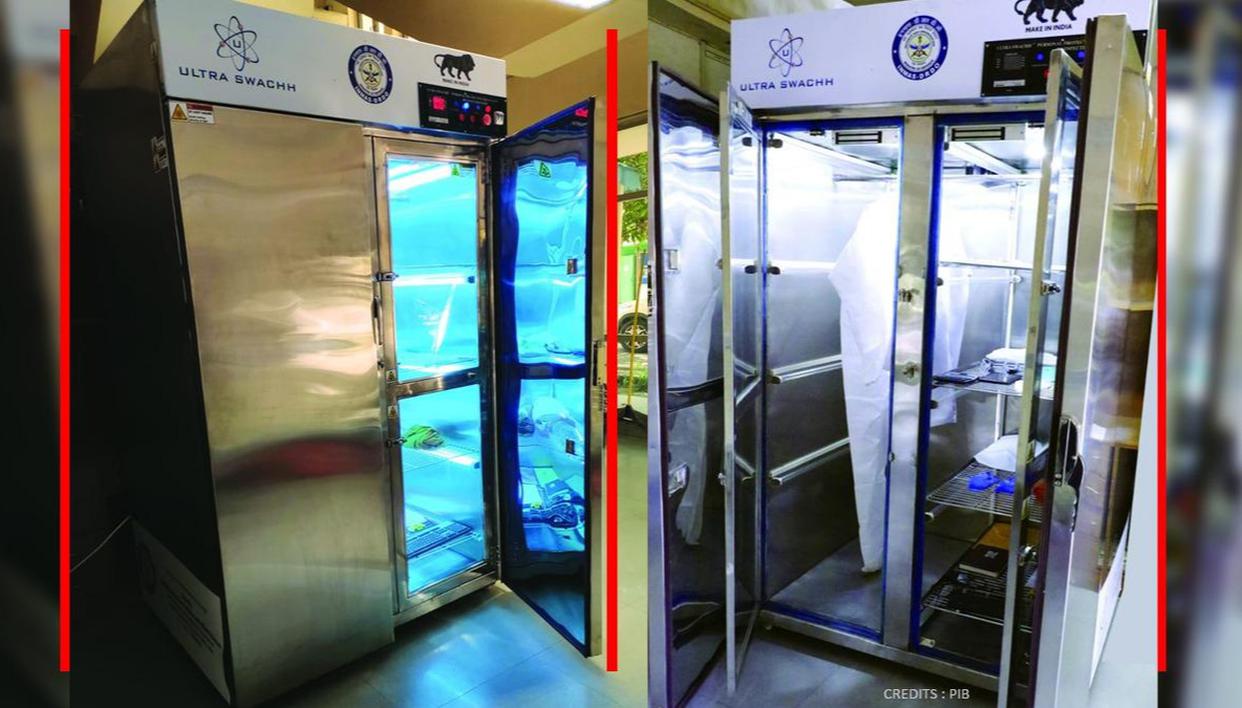
“Ultra Swachh” Booth developed by DRDO to disinfect PPEs


The Defence Research Development Organization (DRDO) developed a disinfection unit called Ultra Swachh. The unit is used to disinfect articles such as electronic items, Personal Protective Equipment, fabrics, etc.

About the unit


  • The Unit uses an advanced oxidative process called Ozonated Space Technology to disinfect the items. 
  • The device also uses Ozone Sealant Technology that involves trapping of Ozone. 
  • The Ultra Swachh Unit houses a catalytic converter that makes it environment friendly. 
  • It also holds several safety features such as door interlocks, emergency shut down, delay cycle, dual doors, leak monitors, etc.
  • The system complies to International Standards of Industrial, Personal, Occupations and Environmental Safety.

Ozone as dainfectntis


  • Ozone is an oxidizing compound that rapidly oxidizes organic materials, manganese, iron, etc. 
  • Ozone is highly unstable and oxidises to form oxygen within 15 to 20 seconds. 
  • This property of ozone is used in disinfection.
  • Because of its high oxidization potential, ozone disinfects or rather oxidises cell components. 
  • When the cellular wall or membrane of a cell gets damaged, the cell falls apart. This process is called lysis. 
  • It is through this process, ozone oxidises or kills microorganisms.